What Is GSM in Fabric? How Fabric Weight Affects Clothing
A lightweight summer T-shirt and a thick cotton sweatshirt may share the same fiber, yet feel very different when you pick them up or wear them. Fabric weight helps explain that difference. On a fabric label or specification sheet, it usually appears as a number followed by GSM.
Numbers such as 120 GSM, 180 GSM and 250 GSM give you a way to compare fabric weights. Understanding them makes it easier to describe the feel you want, whether you're choosing a light pajama fabric or something more substantial for a lounge set.
What Does GSM Mean in Fabric?
GSM stands for grams per square meter. It tells you how much one square meter of fabric weighs: 120 GSM means 120 grams, while 250 GSM means 250 grams for the same area.
You'll also see the unit written as g/m². Because it uses a fixed area, GSM lets you compare fabric weights even when the rolls have different widths.
GSM describes the fabric itself, rather than the weight of a finished garment. A long-sleeved pajama set uses more fabric than a camisole and shorts, so the set can weigh more even when both use the same GSM.
Fabric Weight Chart: Lightweight, Medium-Weight and Heavyweight
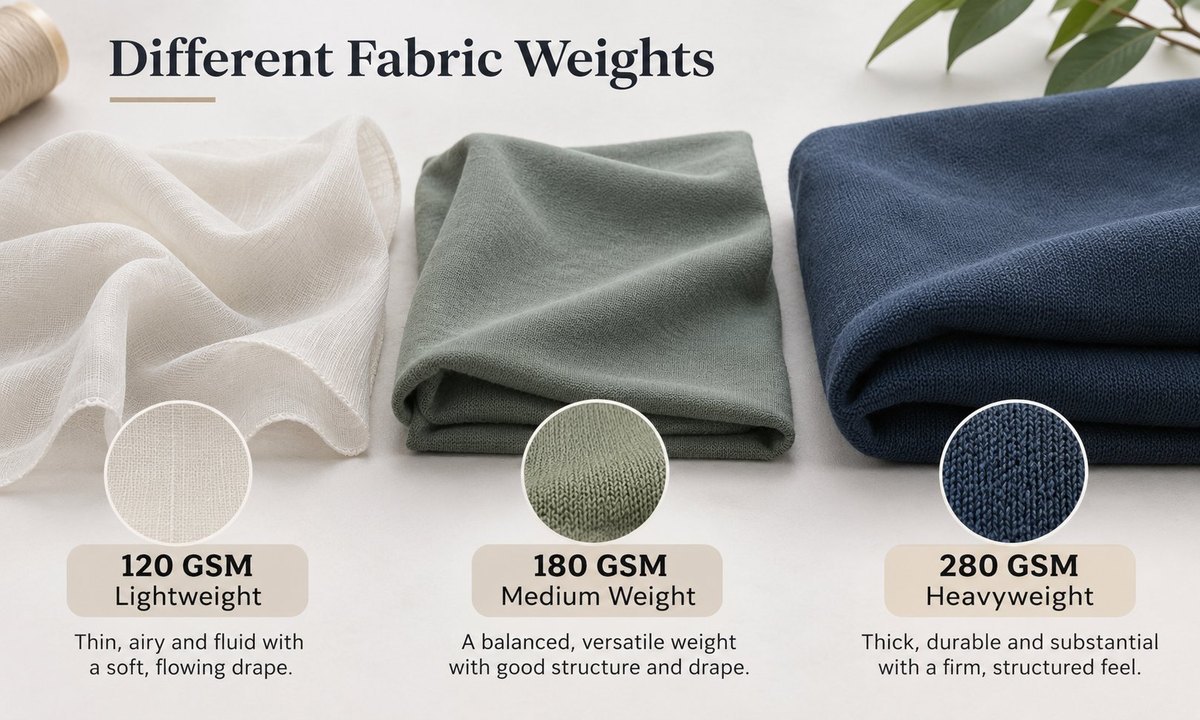
Clothing fabrics are often grouped into three broad weight categories. The chart below is a general reference; suppliers and different fabric categories may use different boundaries.
| Fabric weight | Reference GSM range | Examples | Typical clothing uses |
|---|---|---|---|
| Lightweight | Below 150 GSM | Light cotton poplin, fine jersey, lightweight viscose and satin fabrics | Summer shirts, woven pajamas, camisoles, flowing nightwear |
| Medium-weight | 150–250 GSM | Cotton jersey, modal jersey, interlock, lighter French terry | T-shirts, knit pajamas, casual dresses, lounge sets |
| Heavyweight | Above 250 GSM | Heavier French terry, fleece, substantial knits | Sweatshirts, hoodies, joggers, cooler-weather loungewear |
The categories make more sense within a particular fabric type. A 140 GSM cotton poplin can be a familiar shirt or pajama fabric, while a 140 GSM cotton jersey may feel relatively light for a T-shirt. French terry also spans more than one category, from lighter loop-backed fabrics to heavier sweatshirt weights.
Does Higher GSM Mean Thicker or Better Fabric?
Fabric Weight and Thickness
GSM measures mass per unit area; thickness measures the distance between the fabric's two surfaces. A compact woven fabric and a brushed fleece can have similar GSM values, yet the fleece can feel much thicker because of its raised surface.
This is why weight alone cannot describe how bulky a fabric will feel. Thickness is normally expressed in millimeters and measured under a specified pressure, since compressing a soft fabric changes the reading.
Fabric Weight and Quality
A higher GSM is not a quality grade. A well-made lightweight fabric can have even yarns, a smooth surface and good colorfastness, while a heavier fabric may still pill, shrink excessively or lose its shape.
Quality includes the consistency of the fibers and yarns, the fabric construction, finishing and performance in use. A delicate nightgown and a substantial sweatshirt need different materials; extra weight does not automatically improve either product.
How Does GSM Affect Clothing?
Drape and Shape
Fabric weight contributes to how clothing hangs around the body. A light viscose woven fabric can fall in loose folds, while a heavier jersey can give wide-leg lounge pants more weight as they hang.
Lightness does not always mean fluidity, though. Cotton poplin can feel crisp at a low GSM, while a heavier modal knit can still drape softly. The fabric's flexibility helps determine whether it falls close to the body or holds a clearer outline.
Comfort and Warmth
A lightweight fabric adds little weight to a garment, which suits loose summer pajamas and nightshirts. Heavier knits give sweatshirts and lounge pants the substantial feel associated with cooler-weather clothing.
Warmth also comes from the air held within the fabric. Brushed fleece has a raised surface that traps air, while a compact fabric at a similar GSM can feel less insulating. Airflow and moisture comfort depend on the fiber and construction as well, so GSM works best as a weight reference rather than a breathability rating.
Opacity and Coverage
Within similar fabrics, a higher GSM can provide more coverage. The difference is often noticeable between a fine white jersey and a heavier version used for the same style.
Color, yarn spacing and stretch also affect transparency. A fabric that looks opaque lying flat may become more revealing across the seat or knees when stretched, making coverage particularly relevant for close-fitting pajama bottoms and pale lounge pants.
Garment Weight and Material Cost
For the same fabric area, a higher GSM means more material mass. If a design hypothetically uses 2 m² of fabric, that fabric weighs 300 grams at 150 GSM and 440 grams at 220 GSM, before adding trims or other components.
The effect on cost depends partly on how the fabric is sold. At the same price per kilogram, the heavier option costs more for an equal area. For quotations per meter or yard, fabric width and the quoted rate also matter; GSM alone cannot tell you which option costs less.
What GSM Is Suitable for Pajamas and Loungewear?
A classic button-up pajama set, a soft knit nightgown and a sweatshirt-style lounge set each call for a different feel. The approximate ranges below offer starting points for development.
| Product type | Indicative GSM | Fabric options |
|---|---|---|
| Lightweight woven pajama sets | 90–140 GSM | Cotton poplin, woven viscose, lightweight satin |
| Soft knit pajamas | 140–200 GSM | Cotton, modal or viscose jersey |
| Lightweight nightgowns | 110–190 GSM | Fine cotton fabrics, modal or viscose knits and wovens |
| Everyday lounge sets | 180–260 GSM | Cotton jersey, interlock, suitable modal blends |
| Sweatshirt-style loungewear | 240–350+ GSM | French terry, fleece, heavier knits |
For lightweight woven pajamas, fabrics around 90–140 GSM are a common starting point. Cotton poplin gives cotton pajamas a crisp, structured look, while woven viscose and lightweight satin create softer, more fluid styles.
Knit pajamas often use jersey fabrics around 140–200 GSM, offering a balance of softness, stretch and coverage. For lounge sets, heavier jersey, interlock and French terry provide more substance. Even at the same 300 GSM, French terry and brushed fleece can feel quite different because of their surface construction.
How Is Fabric GSM Measured?
Calculating GSM From a Sample
The calculation divides a sample's weight in grams by its area in square meters:
GSM = Sample weight (g) ÷ Sample area (m²)
A square measuring 10 × 10 cm has an area of 100 cm², or 0.01 m². If it weighs 1.8 grams:
1.8 ÷ 0.01 = 180 GSM
For this sample size, multiplying the weight in grams by 100 gives the GSM. Accurate cutting and a balance sensitive enough for a small specimen are essential; a household scale that rounds to whole grams will be too coarse for this example.
Laboratories measure fabric weight using methods such as ASTM D3776/D3776M, which covers mass per unit area. Sample preparation and conditioning make results more comparable, and a measurement from one small swatch describes that specimen rather than establishing the weight of an entire roll.
Converting GSM to Ounces per Square Yard
Some fabric specifications use ounces per square yard, written as oz/yd². To convert between the two units:
oz/yd² = GSM ÷ 33.906
GSM = oz/yd² × 33.906
| GSM | Approximate oz/yd² |
|---|---|
| 100 | 2.95 |
| 150 | 4.42 |
| 180 | 5.31 |
| 200 | 5.90 |
| 250 | 7.37 |
| 300 | 8.85 |
These conversions apply to weight per square yard. A weight quoted per linear yard also depends on the fabric width and cannot be converted using this factor alone.
How to Choose the Right GSM for Your Collection
Start with the garment's intended feel and shape. A reference such as “a crisp, lightweight button-up pajama set” or “a soft lounge set with enough weight for wide-leg pants” gives a clearer direction than requesting a GSM number on its own.
Then compare swatches within the fabric type you want. Two similar cotton jerseys at different weights can show how much substance or coverage the heavier option adds. Handle the fabric, let it hang and view it against the light to connect the specification with what you can actually feel and see.
Once a fabric is shortlisted, a finished sample brings those choices together. Fit, movement, seams and the appearance after washing help confirm the material in the intended design. Record the approved fabric's composition, construction, finished GSM and agreed weight tolerance so future orders have a clear reference.
Frequently Asked Questions About Fabric GSM
Is 180 GSM Suitable for Summer Clothing?
A 180 GSM jersey can suit summer T-shirts or relaxed knit pajamas when a little more coverage is wanted. A crisp woven summer shirt may use a much lighter fabric, so the appropriate weight differs between these styles.
What GSM Is Used for Hoodies?
Around 250–400 GSM is a useful starting range for many sweatshirt-style hoodies, with lighter and heavier versions available. A lighter loop-backed fabric suits a less bulky layer, while heavier fleece creates a more substantial garment.
Does Fabric GSM Change After Washing?
It can. If fabric shrinks while its mass stays roughly the same, that mass occupies a smaller area and the GSM rises. Loss of fibers or finishes can also affect the result, so before-and-after measurements need comparable drying and conditioning conditions.
Choosing a Weight That Fits the Garment
Once a fabric gives the intended style its shape, feel and coverage, its GSM becomes a useful reference for keeping that choice consistent. Describing the fabric this way makes the specification more meaningful than choosing a number in isolation.
Planning a sleepwear collection? Talk to KoalaPurr about fabric options for your pajama or lounge set designs.